In Portugal, building a professional website costs from 300€ to well over 10,000€: a strategy-led landing page starts at 1,200€, an institutional website sits between 2,400€ and 6,000€, an online store from 6,000€ (full breakdown further down). But the number alone tells you little. What separates a website that works from one that just exists is what never shows up in a price table, and that's what this article is about.
How much does a house cost? Nobody answers that without asking how many bedrooms, which neighbourhood, built how. It's the same with a website: the price depends on what's actually inside it.
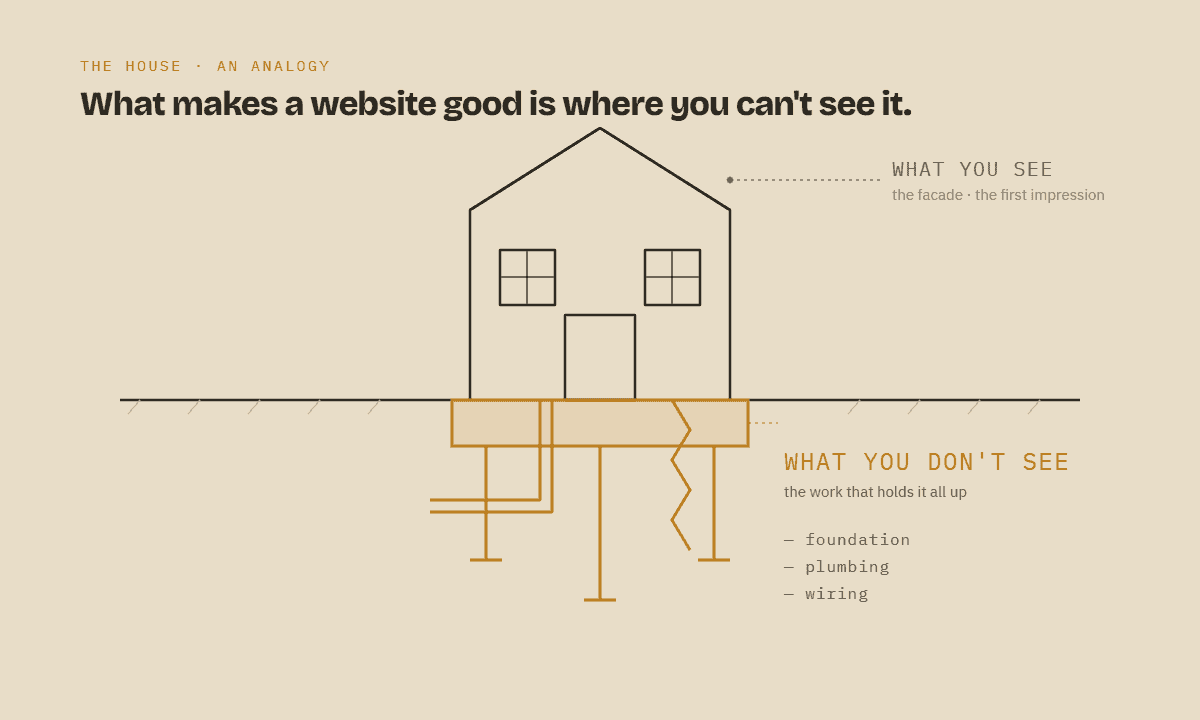
And just like a house, what separates a good one from one that's going to cause problems is almost never what you see from the street. It's the foundations, the plumbing, the insulation. With a website, it's the same thing: almost everything that makes it good lives where you can't see it.
So when someone asks me how much a website costs, the most useful thing I can do isn't give a number. It's show what's underneath, so you know what you're actually paying for. There are six things, and none of them show up in a screenshot.
Strategy, before a single page exists
The foundations of a website aren't visual. They're the questions asked before designing anything: who's your customer, what are they looking for, how do they decide, how do they find you. (None of these get answered by staring at a moodboard.) That work doesn't show up on the finished site, but it decides whether the website works for you or just exists.
A website can be beautiful, even win design awards, and still bring nobody in, if it was built around a visual trend instead of your business. Strategy is what makes sure that isn't the case: understanding who buys, what they type into Google, what makes them trust you before they click "contact." It's the part that rarely shows up as a line item on a quote (there's no pretty way to invoice it), and it's the part that carries the most weight in the result.
If you want to see how that works in practice, I keep a dedicated page on web design in Portugal, with what's included and the prices.
Speed (which you only notice when it's missing)
A good website shows its main content in under two and a half seconds. That's the threshold Google itself defines as good, in what it calls Core Web Vitals. It isn't a technical nicety: when a site is slow, people leave before they see what you've got.
And this has a number behind it, not just my opinion. In a study by Google with Deloitte, across 37 brands and more than 30 million sessions, speeding up load time by just 0.1 seconds increased sales by 8.4%.
Speed is one of the most laborious things to get right and one of the most invisible once it's there. You only notice it the way you only notice a house's insulation the first winter it fails.
Being found by the people looking
A beautiful website nobody finds is like a shop with no window display, on a street with no foot traffic. For Google to show it, a site has to be built to be findable: pages linked to each other, titles and headings using the words people actually type when they search for what you do.
This is spelled out in Google's own guide for anyone who wants to show up in search: Google finds pages primarily by following links, and it surfaces them when titles and content use the terms people search for. You can't see it on screen, but it's the difference between existing online and showing up when someone needs you.
The trust that gets decided in seconds
People decide whether to trust a website almost before they've read it. In a Stanford study of more than 2,600 people, the single most-mentioned factor for judging a site's credibility was, by far, its look (46.1% of the comments analysed, that's the share of comments mentioning design, not the share of people). First impressions aren't vanity: they're what makes someone stay or close the tab.
And there's a detail that changes how a website should be written: people don't read, they scan. The Nielsen Norman Group estimates that on an average visit, a person reads at most about 28% of the words on the page. Clarity (saying the essential thing first, without padding) is work, not luck. A website that respects the reader's time looks simple; getting to that simplicity is one of the hardest things to do well.
Working for everyone
A website that only works well for someone who sees perfectly, hears fine, and uses a mouse with precision leaves people out. According to the World Health Organization, 1 in 6 people worldwide, around 1.3 billion, live with a significant disability.
Accessibility means building so the site works for them too: enough contrast, keyboard navigation, image descriptions. There's an international standard for this, WCAG, defined by the W3C, the body that writes the rules for the web. It isn't a nice-to-have extra. It's reach, it's usability for everyone (it also helps whoever's reading your site on their phone in direct sunlight, or on a weak connection), and in many cases it's a legal requirement.
Actually being yours
This is the most invisible of all, and the one that matters most in the long run: who ends up owning the website once it's built. A website that's actually yours has the domain registered in your name, the code in an account you control, and a system where you change a piece of text yourself, without asking anyone. You can't see it by looking at the site, but it decides everything you can do with it afterwards.
And it isn't just good practice, it has legal backing. European data protection law gives you the right to take your data to another provider. The domain is yours for as long as it's registered in your name, under ICANN's rules, the body that runs the global domain system. Back to the house from the start: you keep the keys. That's what gives you the freedom to take it, change it, and grow with it, without asking anyone's permission.
How much does a website cost in Portugal? The real numbers
In the six sections above, I showed you the work behind the price instead of a bare number. But sometimes you just want to know the number. Here's what gets charged in Portugal right now, and where my own prices sit inside that range.
- Landing page: 300€ to 2,000€
- Institutional website: 350€ to 10,000€
- Online store: 400€ to 12,000€ (complex stores exceed 25,000€)
- Domain (.pt): 10€ to 30€/year
- Hosting: 50€ to 150€/year (shared)
- Maintenance: 40€ to 750€/month
The 350€ and 400€ figures above are market entry floors (Zaask), and they exclude hosting and a database: that's not what an institutional website or an online store typically costs, it's the absolute floor before you add the rest. Every figure here is quoted before VAT. The same basis as my own “starting at” prices below.
That range is wide because “website” covers wildly different things, from a template put together in a weekend to a project built on real research, copy, and custom development. My own prices sit inside that range, not by accident in the middle: they always include research and strategy, copy written for both SEO and AI answer engines, design, and development, as one piece of work, never sold separately.
- Landing page (strategy-led), starting at 1,200€: research, copy, design and build. Not a template.
- Institutional or marketing website, 2,400€ to 6,000€: depending on scope.
- Portal or e-commerce, 6,000€ to 10,000€+: complex builds, integrations, multilingual.
Most premium developers in Portugal don't publish a number at all (“price on request” is practically an industry tradition). I tell you where I start, even though it isn't the cheapest option: a 1,200€ website is the honest floor for something that actually works, not the promise of a 300€ template you'll end up paying more to redo a year from now.
How much does an online store cost?
An online store costs more than an institutional website for the same reason a professional kitchen costs more than a living room: there are more systems running at once. Product catalogue, cart, payments, stock management, invoicing, and often integration with an ERP or accounting tool the business already uses.
In Portugal, a simple online store (a basic catalogue, no integrations) starts at 400€. On a platform like Shopify, a store typically runs 3,000€ to 8,000€; on WooCommerce, 3,000€ to 12,000€. Complex stores, with custom integrations (ERP, multilingual, advanced payments), start at 10,000€ and frequently go past 25,000€. My own e-commerce projects start at 6,000€, because they always include integration with the systems the business already runs on, not a generic store bolted onto a template.
This topic deserves its own article (what changes between Shopify, WooCommerce, and a custom-built store is a long conversation on its own). For now, here's the baseline: the price goes up with how complex what you sell is, not with how many products you list.
How much does website maintenance cost?
Not much, if you're only looking at what's actually yours. The domain costs between 10€ and 30€ a year. Hosting runs 50€ to 150€ a year on a shared plan. That's practically everything a website needs to stay online.
What varies is everything else: “maintenance” plans on the Portuguese market range from 40€ to 750€ a month, depending on what's included (technical updates, backups, content changes, ongoing SEO). I don't sell a fixed maintenance plan: the domain and hosting always stay in your name, without you depending on me to move them anywhere (same logic as the “Actually being yours” section above).
What I offer, for anyone who wants to keep growing after the site is live, is the Parceria: strategy, marketing, content, and the development to execute it, from 500€/month. It isn't maintenance. It's continuing to work on the site, not just keeping it standing.
Buy, rent, or build on a platform? The three ways to pay for a website
Beyond how much, there's how, and the market sells websites in three ways. On website builders (Wix, Squarespace, Shopify), you pay the platform a monthly fee, from around 13€ a month, and build the site yourself (or pay someone to build it in there). With website rental, an agency or freelancer builds and hosts it, and you pay for as long as it's up; in Portugal, the public plans I found run from 25€ to 125€ a month, with domain, hosting and support included. And with a per-project purchase, the model most professionals work with (mine included), you pay for the work once and the site is yours.
The platform is the right choice for testing an idea on a minimal budget, or when you enjoy doing things yourself. The trade-off is time: you do the work, and the site lives inside the platform; if you leave, you take the domain and the content, not the site.
Rental suits anyone who wants a professionally built site with no upfront investment: cheap to start, everything handled. The maths deserve attention once the site becomes permanent: 80€ a month is 960€ a year, close to 2,900€ by year three, and the meter keeps running, without the site ever becoming yours.
With a per-project purchase, the cost is concentrated at the start (the real numbers are above) and keeping it online costs little: the domain (10€ to 30€ a year) and hosting (50€ to 150€ a year). It's the model that makes sense when the site is meant to last.
Whatever the model, and whoever you're talking to (me included), four questions are worth asking of any proposal: whose name is the domain in? Is the site mine or yours? What do I take with me if I leave? And what exactly is included in the price? Anyone doing good work answers all four without hesitating, in any of the three models.
So, how much does a good website cost in Portugal?
Back to the question from the start: how much does a good website cost? It depends on how much of this invisible work is actually inside it. In Portugal you'll see websites advertised anywhere from a few hundred to tens of thousands of euros, and the price difference is almost entirely what you just read: strategy, speed, being found, trust, working for everyone, and staying yours.
A good website isn't the prettiest or the cheapest. It's the one where this work got done, and that's why it lasts, brings in customers, and is still yours a few years from now.
What I do, and what each project includes, is on the services page. And if you're thinking about a website and want to work out what makes sense for your case, tell me what you need. I'll tell you honestly what's needed, and what isn't.
Sources
- Google · Core Web Vitals (LCP ≤2.5s = "good")
- Google + Deloitte · "Milliseconds Make Millions" (37 brands, 30M+ sessions, 0.1s → +8.4% sales)
- Google Search Central · SEO Starter Guide (pages found via links; titles/content matched to search terms)
- Stanford Web Credibility Research (Fogg et al., 2,684 comments, design = most-mentioned credibility factor at 46.1%)
- Nielsen Norman Group · "How Little Do Users Read?" (≤28% of words read per visit)
- World Health Organization · Disability and health fact sheet (1 in 6 people / 1.3 billion)
- W3C / WAI · Web Content Accessibility Guidelines (WCAG)
- GDPR, Article 20 · Right to data portability
- ICANN · Registrant Rights and Responsibilities (domain ownership tied to registrant record)
- Modular Digital · “Quanto Custa Criar um Site em Portugal em 2026?” (market ranges: landing, institutional, store, domain, hosting)
- Modular Digital · “Quanto Custa a Manutenção de um Site em Portugal?” (monthly maintenance tiers)
- Zaask · Website creation price table (entry-floor, institutional and e-commerce ranges, PT market)
Wix Portugal · Premium plans (from ~13€/month, 2026)
Portuguese website-rental providers · public plan pages (~25€ to ~125€/month, 2026)

